
Avec 20 ans d'expérience dans la fabrication, nous offrons un service complet couvrant la conception de moules, la fabrication de moules, le moulage par injection et la production de produits finis.




Avec 20 ans d'expérience dans la fabrication, nous offrons un service complet couvrant la conception de moules, la fabrication de moules, le moulage par injection et la production de produits finis.
When a new plastic part moves from drawing to production, the question that decides the launch date is almost always the same: how long does it take to make an injection mold? The honest answer is a range. A straightforward single-cavity mold can be ready for first samples in three to five weeks, while a large, multi-cavity tool with a hot runner and a fine texture can take eight to twelve weeks. This guide breaks a typical custom mold project into stages, shows what happens in each one, and explains how your own decisions — and your approval speed — affect the schedule.
Tooling sits on the critical path of every hardware project. A mold that arrives two weeks late delays the whole production plan: sampling, certification, packaging and the first shipment to your customers. When you compare quotations, compare lead times and the assumptions behind them as carefully as you compare price. A lower tooling price is not a saving if it costs you a market window.
The table below shows a realistic schedule for a medium-complexity production mold. Durations are in working days, assuming a complete data package and prompt approvals.
| Stage | Typical duration | What you receive |
|---|---|---|
| 1. Quotation & DFM review | 1–3 days | Price, DFM report, mold specification |
| 2. Mold design (3D + 2D) | 2–5 days | Mold design and drawing for approval |
| 3. Steel & standard components | 3–10 days | Mold base, cavity and core steel, hot runner |
| 4. CNC machining of cavity, core & inserts | 5–12 days | Machined mold components |
| 5. EDM & wire cutting | 3–8 days | Electrodes, sharp corners, deep ribs, fine detail |
| 6. Polishing, texturing & surface treatment | 2–6 days | Finish polished or textured to specification |
| 7. Assembly, fitting & spotting | 2–4 days | Complete mold ready for trial |
| 8. T1 mold trial & sample inspection | 1–3 days | First-shot samples and a dimensional report |
| 9. Modification & T2 trial | 2–7 days | Corrected samples for approval |
Some stages overlap — steel is ordered while the design is being finalised, and electrodes are cut while the cavity is still on the machine — which is why the total is shorter than the sum of the parts. As a rule of thumb: 3–5 weeks for a simple single-cavity mold, 5–7 weeks for a typical multi-cavity production mold, and 8–12 weeks for large or highly complex tooling.
We review your 3D model and 2D drawing, check wall thickness, draft, ribs, undercuts and gate position, then issue a quotation together with a design-for-manufacturing (DFM) report. This is the cheapest moment to change a design. Send STEP, IGES or STL files plus a PDF drawing with tolerances, the material you intend to use, the surface finish, and your annual volume.
The mold designer lays out the parting line, cavity layout, runner system, cooling circuit, ejection and any sliders. This is the stage where schedules are most often lost, because the design clock cannot restart until you approve it. Reviewing the design within 24–48 hours is the single most effective way to shorten your lead time.
Mold base, cavity and core steel, hot runner system, ejector pins and springs are ordered in parallel with the design work. Standard mold bases and locally available steels ship in a few days; special steels, hardened inserts or imported hot runners take longer. Material availability, not machining, sets the floor for many schedules.
Rough and finish milling of the cavity and core, drilling of cooling channels and machining of inserts. Hard milling of pre-hardened steel is often done at this stage rather than after heat treatment, which saves several days on hardened molds.
Where a cutter cannot reach — sharp internal corners, deep ribs, fine texture detail — sinker EDM and wire cutting finish the job. Electrodes are machined in parallel with the milling work to keep this stage short.
The cavity surface is polished, sandblasted or etched to the SPI finish or texture number on your drawing. A mirror finish or a deep VDI texture takes longer than a standard matte finish, and any texture change after this point means re-polishing or re-etching the cavity.
The mold is assembled and spotted: parting surfaces are fitted, slides and lifters are matched, cooling and ejection are tested by hand, and alignment is checked before the trial.
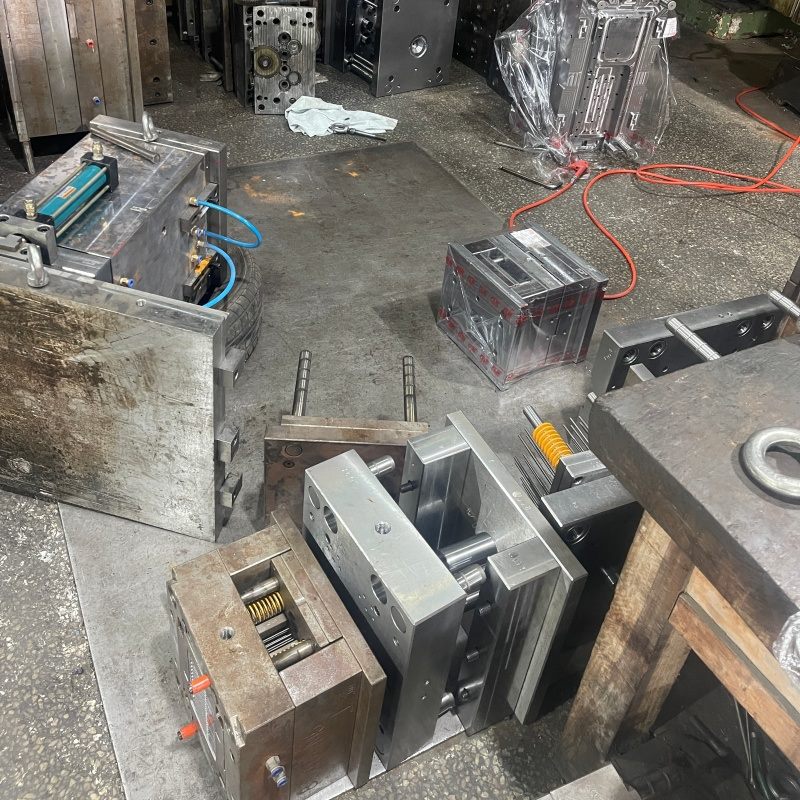
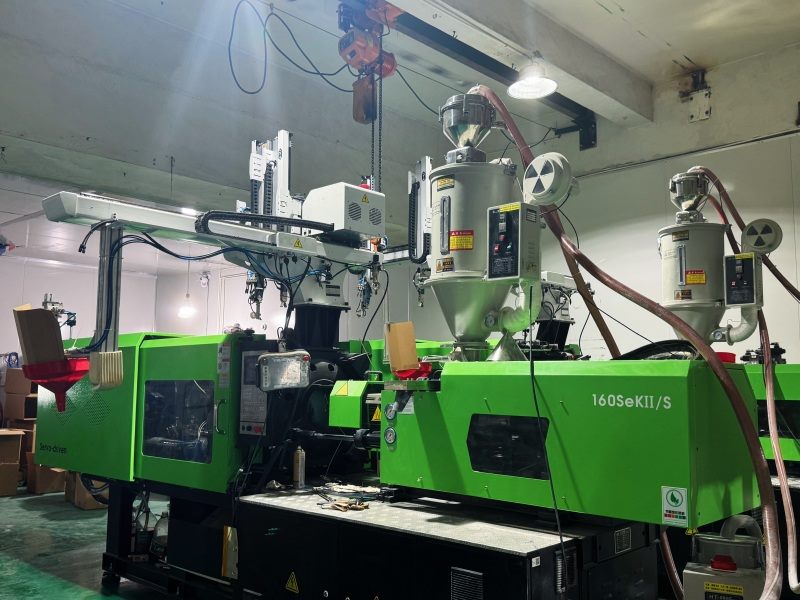
The first trial (T1) confirms that the mold fills correctly, ejects reliably and holds dimensions. Samples are measured on a CMM or projector, and you receive a dimensional report together with the sample parts. Most molds need one round of adjustment at this point — that is normal, not a defect in the project.
Small corrections — gate size, cooling, one tight dimension — are made and a second trial is run. Combined into a single round, most projects reach approval after T2. Batching comments from several departments into one review avoids three or four small trial rounds, each of which costs days.
Once samples are signed off, the mold moves to production. The first production batch — molding, inspection, assembly and packaging — typically ships within 7–15 days depending on quantity and secondary operations.
A two-cavity ABS housing mold with a standard finish, no side actions and customer approvals within 48 hours:
| Timing | Activity |
|---|---|
| Day 1–2 | Quotation and DFM review; mold specification agreed |
| Day 2–6 | Mold design completed and approved; steel ordered on day 3 |
| Day 3–10 | Mold base and steel delivered to the machine shop |
| Day 6–18 | CNC rough and finish machining of cavity, core and inserts |
| Day 12–20 | EDM and wire cutting, run in parallel with machining |
| Day 18–23 | Polishing and texturing |
| Day 21–24 | Assembly, fitting and spotting |
| Day 25–27 | T1 trial, dimensional report, samples shipped to you |
| Day 28–32 | Minor correction and T2 trial; samples approved |
Between three and twelve weeks from purchase order to approved samples. Simple single-cavity molds commonly finish in 3–5 weeks, typical multi-cavity production molds in 5–7 weeks, and large or highly complex tools in 8–12 weeks.
Yes, within limits. Parallel machining shifts, standard mold components, pre-hardened steel that skips heat treatment and immediate design approval typically compress a schedule by 20–30%. Some stages — heat treatment, texture etching, hot runner delivery — cannot be compressed without risking mold quality.
Design changes after steel cutting, slow approval of the mold design or of the trial samples, and incomplete 3D data at the start. Technical machining delays are far less common than communication delays.
Plan to start tooling six to eight weeks before your target production date for a standard part, and ten to twelve weeks for complex tooling, so that trials and corrections fit comfortably inside the schedule.
Send your 3D model and 2D drawing to Heyuexin Technology and we will return a free DFM review, a quotation and a stage-by-stage lead-time plan for your mold, so you can see exactly when the first samples will arrive. Our engineering team supports everything from prototype tooling and low-volume production to multi-cavity production molds, injection molding, CNC machining and assembly.
Upload your STEP, IGES or PDF files and tell us your target launch date — we will confirm the timeline before you place the order.

Droits d'auteur © 2026 Xiamen Heyuexin Technology Co., Ltd. Tous droits réservés .
laisser un message
Scannez vers WeChat :

Scannez vers WhatsApp :